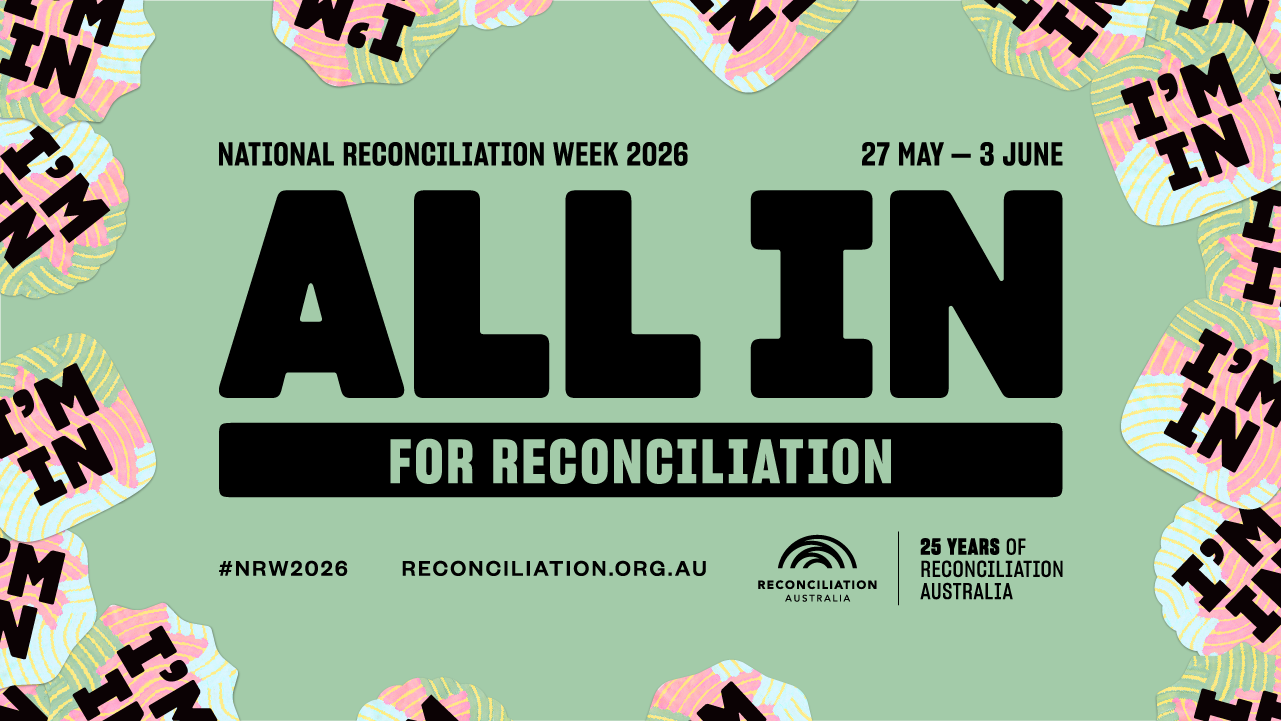
During National Reconciliation Week in Australia (27 May to 3 June), organisations across the country are encouraged to reflect on their role in advancing reconciliation. These dates are significant. They mark two pivotal moments in Australia’s history: the 1967 referendum and the High Court Mabo decision, both of which fundamentally reshaped the nation’s relationship with Aboriginal and Torres Strait Islander peoples, by valuing Aboriginal and Torres Strait Islander peoples, histories, cultures, and futures.
Since its beginnings as the Week of Prayer for Reconciliation in 1993, and the establishment of National Reconciliation Week in 1996, the week has evolved into a national platform for reflection and action. This year’s theme, “All In”, is grounded in a call for advancing Aboriginal and Torres Strait Islander peoples’ rights as a shared commitment from all Australians.
Inclusion in the Workplace
Inclusion is often addressed through workforce policies, or internal cultural initiatives. These efforts are important, but they represent only one dimension of an approach to reconciliation.
A more immediate way to take action on reconciliation is procurement.
If inclusion is treated as a genuine organisational priority, it’s important to reflect this in purchasing decisions. Every supplier relationship determines how economic value is distributed – who receives revenue, who scales, and who gains access to long-term commercial opportunity.
In this sense, inclusion is not only a cultural or HR objective. It is a financial and strategic decision-making framework.
Supplier Diversity as Economic Participation
Supplier diversity shifts inclusion from aspiration to practice. It involves intentionally engaging businesses owned by underrepresented groups, including Indigenous-owned enterprises, as part of core commercial operations.
Across Australia, there is a growing ecosystem of Indigenous-led businesses.
For example, Kulbardi, Australia’s largest Indigenous-owned workplace supplier, provides organisations with access to everyday essentials such as office supplies and workwear.
Kooya Fleet Solutions is a 100% Aboriginal-owned fleet leasing and management company, partnering with organisations nationally while reinvesting profits into Indigenous-led initiatives that extend its social impact beyond commercial transactions.
Elephant in the Room Consulting works with organisations to develop cultural capability, leadership, and inclusive practice.
The Shift Required of Business Leaders
These Indigenous owned businesses and others can be considered as part of an inclusive supplier procurement strategy.
For leaders within small and medium enterprises, considering how to make meaningful progress on reconciliation can start with small decisions relating to procurement. At the point of decision-making it’s worth considering:
- Who are we choosing to buy from?
- Which businesses are we enabling through our spend?
- What economic and social outcomes are embedded in our supply chain?
These questions reposition procurement as an opportunity for both commercial performance and social impact.
From Awareness to Practice
Many organisations already recognise the importance of inclusion. The challenge lies in operationalising it consistently, beyond statements of intent or annual events.
Procurement offers one of the most direct mechanisms to do this. It connects organisational values to financial decisions, and organisational choices to measurable outcomes.
In the context of National Reconciliation Week (27 May–3 June) and the call to go “All In,” this becomes particularly relevant. Reconciliation is not advanced through awareness alone. It is advanced through decisions that redistribute opportunity, build capability, and strengthen participation, with Indigenous Australians.
An inclusive approach to procurement ultimately determines who your business takes on its growth journey and facilitates economic empowerment of Indigenous Australians.
